 Skip to content


Little Millet (Saamai): How to Cook It, Water Ratios and Everyday Recipes
Little millet has a mild flavour that works well with familiar South Indian meals. You can serve it with sambar, turn it into vegetable upma, or cook it softer for pongal. The key is choosing the water quantity for the texture you want, rather than using one ratio for every dish.
What is little millet?
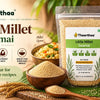
Little millet, sold as Saamai at Theerthaa, is a small cereal grain used in everyday cooking. Its gentle flavour makes it useful in dishes where vegetables, pulses and seasonings provide most of the taste.
The regional names listed for Theerthaa’s product are:
- Tamil: Saamai / சாமை
- Telugu: Saamalu / సామలు
- Malayalam: Chaama / ചാമ
- Kannada: Saame / ಸಾಮೆ
- Hindi: Kutki / कुटकी
Use hulled, food-grade millet for these recipes, not grain sold with its inedible outer husk intact.
Which texture should you aim for?
For a bowl served with dal or curry, aim for tender grains that hold their shape. Upma can be slightly softer, while pongal needs a moist consistency that brings the millet and dal together.
This distinction matters more than finding a single correct water ratio. Soaking, draining, the saucepan lid and the intensity of the heat all affect how much water remains during cooking.
If you are still choosing a variety, our beginner’s guide to Indian millets introduces the different options.
Little millet, kodo millet or barnyard millet?
These are different grains, not interchangeable names. Alongside Little Millet / Saamai, Theerthaa stocks Kodo Millet / Varagu and Barnyard Millet / Kuthiraivali.
All three offer ways to vary your grain-based meals. Start with one variety and learn how it behaves in your saucepan before applying the same method to another. Our complete guide to Indian millets provides broader background.
Explore Little Millet / Saamai for the cooking ideas below.
Explore Little Millet / SaamaiHow to cook little millet on the stovetop
For your first batch, use ½ cup dry millet so you can adjust the texture without cooking a large quantity. These quantities are starting points, not batch-tested instructions. Follow pack instructions if they differ.
Tender grains to serve with a meal
- Rinse ½ cup millet in a fine-mesh sieve.
- Soak for 20–30 minutes, then drain thoroughly.
- Add the drained millet and 1 cup fresh water to a saucepan.
- Bring to a boil, cover and reduce the heat to a gentle simmer.
- Begin checking after 10 minutes. Continue until the grains are tender and the water is absorbed.
- If the grains are still firm and the pan is dry, add 1–2 tablespoons hot water, cover and continue cooking.
- Switch off the heat and rest, covered, for 5–10 minutes before gently fluffing.
This is a starting ratio of 1 part dry millet to 2 parts cooking water, measured by volume before soaking. For a softer result, start with ½ cup millet and 1¼ cups water. Avoid applying these stovetop quantities directly to a pressure cooker, where evaporation is different.
Everyday little millet recipes
Vegetable Saamai upma
Use ½ cup little millet, rinsed, soaked and drained; 1¼ cups water; 1 teaspoon cooking oil; ¼ teaspoon mustard seeds; a few curry leaves; ¼ cup chopped onion; and ½ cup finely chopped vegetables.
Heat the oil, add mustard seeds and let them splutter. Add curry leaves, onion and vegetables, then sauté. Add the water and salt to taste. Bring to a boil, stir in the millet, cover and simmer gently until tender. Add a little hot water if needed, then rest before serving.
A simple millet meal bowl
Serve cooked Little Millet / Saamai with dal or sambar and a vegetable side. Begin by replacing the grain portion of one familiar meal, rather than changing the entire menu.
Soft Saamai pongal
Combine ½ cup rinsed little millet with ¼ cup rinsed split moong dal and 2½ cups water in a roomy saucepan. Simmer gently until both are soft, adding hot water as needed. Stir regularly towards the end to prevent sticking.
Finish with a tempering of cumin, crushed pepper, ginger and curry leaves. The goal is a soft, spoonable consistency, not separate grains.
Storage and common cooking problems
Keep dry millet in a tightly closed container in a cool, dry place. Follow the pack’s best-before date and storage instructions.
Refrigerate cooked millet promptly in a covered container rather than leaving it at room temperature for extended periods. Reheat only the portion you need until steaming hot.
If your millet is mushy, use slightly less water next time and avoid stirring repeatedly. If it is firm, add a little hot water and continue cooking gently. If it catches on the bottom, lower the heat and check that your lid fits properly.
Frequently asked questions
Do I need to soak little millet?
The method above uses a short soak. Unsoaked millet can require a different cooking time and water quantity, so keep your preparation consistent while learning the grain.
What is the little millet water ratio?
For soaked and well-drained millet cooked on the stovetop, start with 1 part dry millet to 2 parts fresh water. Use more for softer dishes and adjust to your grain and saucepan.
Can I use little millet instead of rice?
You can serve it in place of rice with dal, sambar or curry. Its texture is different, so it will not behave identically in every rice recipe.
Is Saamai the same as Thinai?
No. Saamai is little millet, while Thinai is foxtail millet.
Why does little millet become sticky?
Too much water, prolonged cooking and frequent stirring can produce a softer, stickier result. That can suit pongal, but is less useful when you want separate grains.
Explore millets at Theerthaa
The information in this article is for educational purposes only and is not a substitute for professional medical advice. Consult your doctor before making dietary changes.





:%20How%20to%20Cook%20It,%20Water%20Ratios%20and%20Everyday%20Recipes)