Skip to content


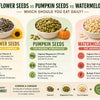
Sunflower Seeds vs Pumpkin Seeds vs Watermelon Seeds: Which Should You Eat Daily?
Sunflower Seeds vs Pumpkin Seeds vs Watermelon Seeds: Which Should You Eat Daily?
Walk into the dry fruits and seeds section of any Indian grocery store and you'll find all three — sunflower seeds, pumpkin seeds, and watermelon seeds — often sitting next to each other at similar prices. Most people pick one, eat it for a few weeks, then switch to another without much reason.
The truth is that each of these seeds has a genuinely different nutritional profile and serves different health goals. This comparison will help you choose based on what you're actually trying to achieve.
Nutritional Comparison (per 30g serving)
| Nutrient | Sunflower Seeds | Pumpkin Seeds | Watermelon Seeds |
|---|---|---|---|
| Calories | 174 kcal | 163 kcal | 158 kcal |
| Protein | 6g | 9g | 8g |
| Fat (total) | 15g | 14g | 13g |
| Omega-6 | High (linoleic acid) | Moderate | Moderate |
| Omega-3 (ALA) | Low | Low-moderate | Low |
| Dietary Fibre | 3g | 1.8g | 1.5g |
| Zinc | 1.5mg (14% DV) | 2.2mg (20% DV) | 2.9mg (26% DV) |
| Magnesium | 91mg (22% DV) | 156mg (37% DV) | 139mg (33% DV) |
| Vitamin E | 11mg (73% DV) ★ | 0.6mg (4% DV) | 0.1mg (1% DV) |
| Iron | 1.5mg | 2.7mg | 0.4mg |
| Arginine (amino acid) | Moderate | High | Very High ★ |
Looking at that table, a few things stand out immediately: sunflower seeds dominate on vitamin E; pumpkin seeds lead on magnesium and iron; watermelon seeds have the highest zinc and arginine content of the three.
What Each Seed Does Best
Sunflower Seeds — The Vitamin E Champion
Sunflower seeds are the most vitamin E-dense whole food available. A 30g serving provides 73% of your daily vitamin E requirement. Vitamin E is a fat-soluble antioxidant that protects cell membranes from oxidative damage — particularly relevant for skin health, cardiovascular protection, and immune function.
Best for: People who want antioxidant support, skin health, or cardiovascular protection. Vegetarians who don't eat eggs or dairy (other vitamin E sources) benefit especially. Vitamin E also supports healthy hair and is often deficient in Indian diets that rely heavily on refined oils (which have their natural vitamin E removed during processing).
The omega-6 consideration: Sunflower seeds are high in linoleic acid (omega-6). Most Indian diets already have too much omega-6 relative to omega-3. This doesn't make sunflower seeds harmful — they're a whole food with fibre and protein unlike refined sunflower oil — but it means they shouldn't be your only fat source.
Pumpkin Seeds — The Mineral Powerhouse
Pumpkin seeds have the most balanced mineral profile of the three. They lead on magnesium (37% DV per 30g), have strong iron and zinc content, and provide 9g of protein per serving — the highest of the three seeds.
Best for: Men (zinc and magnesium support testosterone and prostate health), people with poor sleep or muscle cramps (magnesium), anaemia risk (iron), and anyone wanting a higher-protein seed. Pumpkin seeds are also the most filling per serving due to their protein content.
Watermelon Seeds — The Underrated One
Watermelon seeds are the most overlooked of the three — most people discard them — but they're nutritionally impressive. They have the highest zinc content (26% DV per 30g), very high arginine content, and strong magnesium levels.
Arginine is an amino acid that the body converts to nitric oxide, which relaxes and dilates blood vessels. This is relevant for blood pressure management and cardiovascular health. Watermelon flesh is known for citrulline (which converts to arginine), but the seeds are even richer in arginine directly.
Best for: Cardiovascular health, blood pressure support, men's health (zinc + arginine combination is relevant for circulation and reproductive health), and anyone looking for a lower-cost zinc source compared to pumpkin seeds.
Head-to-Head: Which to Choose for Specific Goals
| Health Goal | Best Choice | Why |
|---|---|---|
| Skin health & antioxidants | Sunflower Seeds | 73% daily vitamin E per serving |
| Men's health (testosterone, prostate) | Pumpkin Seeds | Highest magnesium + good zinc + phytosterols |
| Blood pressure & heart health | Watermelon Seeds | Highest arginine → nitric oxide production |
| Zinc (immunity, wound healing) | Watermelon Seeds | Highest zinc of the three (26% DV) |
| Protein per serving | Pumpkin Seeds | 9g vs 6–8g in the others |
| Fibre & digestion | Sunflower Seeds | 3g fibre vs 1.5–1.8g in the others |
| Sleep & muscle cramps | Pumpkin Seeds | Highest magnesium (37% DV) + tryptophan |
| Budget (nutrition per rupee) | Watermelon Seeds | Often the lowest cost with strong zinc + protein |
Can You Eat All Three Together?
Yes — and combining them is actually smart. A daily seed mix of sunflower + pumpkin + watermelon seeds gives you comprehensive coverage:
- Vitamin E from sunflower seeds (what neither of the others provide well)
- Magnesium and iron from pumpkin seeds
- Arginine and zinc from watermelon seeds
A practical daily mix: 10g each of all three (30g total) as a snack or sprinkled over a meal. This is more nutritionally varied than eating 30g of any single seed.
How to Eat Each One
Sunflower seeds
- Sprinkle on curd or yoghurt bowls
- Add to millet upma or pulao for crunch
- Eat raw as a desk snack — they're mild and easy to eat by the handful
- Blend into smoothies (they're softer than pumpkin or watermelon seeds)
Pumpkin seeds
- Light dry roast in a pan for 3–4 minutes to enhance flavour
- Add to trail mix with almonds and walnuts
- Sprinkle on ragi or foxtail millet porridge
- Eat 20–30g as an evening snack before bed (tryptophan + magnesium for sleep)
Watermelon seeds
- Dry roast with a pinch of salt and pepper — transforms them completely
- Grind into a paste for chutney (traditional in some South Indian dishes)
- Mix into laddoo or energy ball recipes
- Add to khichdi or rice dishes as a protein-boosting garnish
Frequently Asked Questions
Which seed is best for weight loss?
All three help with weight management through satiety — their protein and fat content keeps you full longer than carb-based snacks. Sunflower seeds have slightly more fibre (3g per 30g), which may extend fullness. The most important factor is using any of them to replace a higher-calorie snack like biscuits or fried snacks.
Can I eat all three seeds every day?
Yes — 30g total per day across all three is a practical, nutritionally balanced daily amount. Avoid eating large amounts of any single seed — variety gives you better micronutrient coverage.
Which is easiest to digest?
Sunflower seeds are the softest and easiest to digest raw. Pumpkin and watermelon seeds are harder and benefit from light roasting or soaking for 2–4 hours before eating if you have a sensitive digestive system.
Are these seeds safe for children?
Yes, from around 3–4 years old. Start with ground seeds rather than whole seeds for younger children to avoid choking. A teaspoon of ground seeds in porridge or smoothies is a good starting amount.
Which seed has the most protein?
Pumpkin seeds lead at ~9g per 30g serving. Watermelon seeds are close at ~8g. Sunflower seeds provide ~6g. All three are solid plant-based protein sources compared to most grains and vegetables.
- Posted in:
- healthy snacks
- pumpkin seeds
- seeds
- seeds comparison
- sunflower seeds
- watermelon seeds
- weight loss